Ancient Echoes of Egypt: Exploring the Sacred Archetypes through Art

Updated: Feb 4
As a child, I was deeply fascinated by Ancient Egypt. Its gods, symbols, and stories felt vast and mysterious—charged with meanings that stretched far beyond what I could fully understand.
This project was an invitation to return to that feeling: to see the world again with awe, curiosity, and reverence for the old myths.
Creating this series allowed me to reconnect with a sense of wonder that gets forgotten while growing up. These works are not historical recreations, but intuitive interpretations—visual meditations on ancient archetypes. Through this process, I realised that Egyptian mythology will likely continue to surface in my work, guiding my visual language and narrative instincts.
Below are six pieces from this series.
The Pharaoh
The figure of the Pharaoh stands at the centre of Egyptian mythology, embodying divine authority and ritual power. In Ancient Echoes, the Pharaoh is portrayed through a collage-style composition that layers traditional Egyptian symbols such as the crook and flail, the ankh, and the serpent. These elements evoke the Pharaoh’s role as both a political leader and a spiritual intermediary.
The artwork invites viewers to reconsider the power and responsibility of the Pharaoh. He was not merely a political ruler, but the divine embodiment of the gods on Earth. Through this lens, the piece encourages reflection on life, death, and the pursuit of immortality.

Thoth, God of Wisdom and Knowledge
Thoth, often depicted as a blue avian deity, is credited with bringing knowledge to humanity. He is the guardian of sacred texts and the legendary Emerald Tablets, which remain enigmatic even to modern science. In the series, Thoth symbolises the pursuit of wisdom and the preservation of knowledge across time.
The artwork captures Thoth’s writing the Emerald Tablets. I was listening to the audiobook narration while working on this piece. I felt this deep yearning to remember knowledge that is now forgotten. It opens our imagination and makes us wonder: Is profound knowledge ancient magic?

Ancient Egyptian Temple of Sobek
Sobek, the crocodile god of the Nile, represents primal instincts, survival, and raw power. Ancient temples dedicated to Sobek often housed live crocodiles, which were honoured and fed as sacred beings. This practice illustrates the deep connection between humans and nature’s untamed forces.
In Ancient Echoes, the Temple of Sobek is an homage to this relationship. The artwork portrays the crocodile as a symbol of resilience and the instinctual drive to endure. It challenges modern viewers to reconnect with their own primal energies and recognise the strength found in embracing instincts. This artwork also shows the Orion Belt, which has been believed to have cosmological significance to the ancient Egyptians.

Wrath of Apep and the Eternal Battle
Apep, the cosmic serpent, devoures the sun each night, threatening the order of the world. Ra’s nightly battle with Apep in the underworld symbolizes the struggle between chaos and order. This myth reminds us that every new day is earned through perseverance and courage.
The series captures this eternal conflict with dynamic imagery that conveys tension and renewal. Apep’s menace and Ra’s determination invite viewers to consider their own battles with darkness and uncertainty. The artwork suggests that chaos is not merely destructive but also a catalyst for growth and transformation. It encourages embracing challenges as essential parts of life’s cycle and be greatful for each day.

Ra, the Sun God and Source of Life
Ra, the sun god, is the source of light, order, and life itself. His endless journey between worlds represents the continuous cycle of renewal and balance. In the visual series, Ra’s presence is set in stone. Something permanent, like the sun.
The depiction of Ra emphasizes movement and illumination, symbolising clarity and purpose. It invites reflection on how light—both literal and metaphorical—guides human experience. RA - is an energy, connecting with the Sun - you directly tap into it.

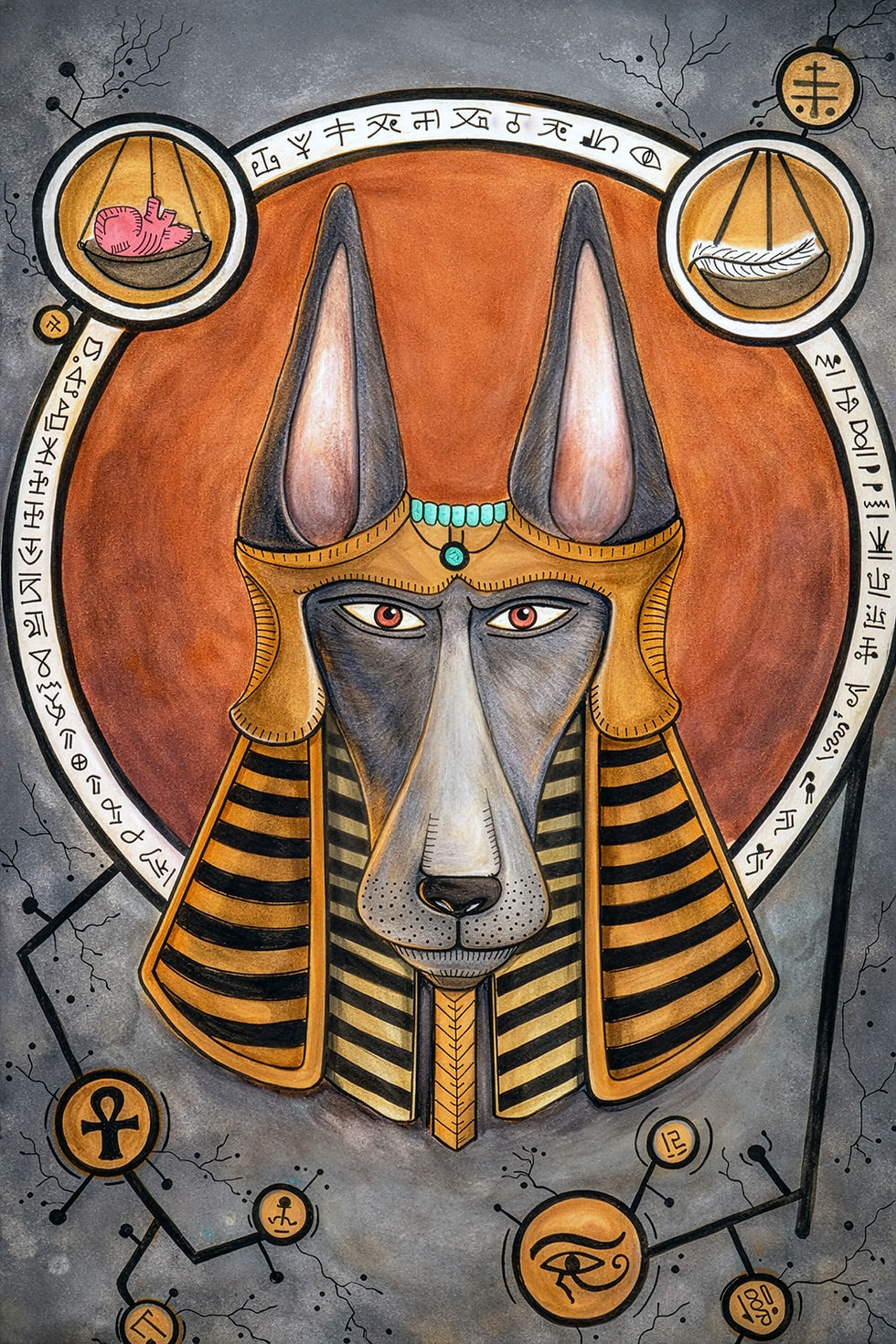
Anubis — Ancient Egyptian God of the Afterlife
Anubis appears as a jackal-headed, humanoid deity, guardian of the dead and guide of souls through the underworld. He presides over the sacred weighing of the heart, measuring it against the feather of Ma’at—symbol of truth and balance. Only those whose hearts are light, free from corruption and excess, are permitted to move forward into the next realm. This piece reflects the ancient belief that morality, not power, determines one’s fate beyond life.
On Process & Transparency
In a time when AI and digital tools are increasingly part of the creative landscape, I believe transparency matters.
Each artwork in this series begins by hand. I start with a pencil drawing, then build the piece using vibrant acrylic paints and ink pens to define the line work. Once the physical artwork is complete, it is scanned and brought into a digital workspace, where I adjust color balance, refine contrast, and apply subtle digital filters to arrive at the final image. I used Adobe Photoshop and Chat GPT for the final results.
To maintain clarity around authorship and process, I’ve also shared versions of the work without digital enhancement—allowing viewers to see the piece at its origin, before post-production.
The digital stage is not used to replace the artwork, but to extend it—preserving texture, color, and atmosphere as closely as possible to the original hand-made piece.
Why These Archetypes Matter Today
Ancient Egyptian symbols and myths endure because they tap into universal human experiences. Wisdom, knowledge, struggle, and renewal are themes that remain relevant across cultures and eras. By exploring these archetypes through modern art, Ancient Echoes bridges the gap between ancient wisdom and contemporary life.
All Artworks by Roshni Ali created in 2024.

Roshni Ali is a Goa-based artist actively engaged in the region’s music and wellness communities. Her work explores mythic, magical, and supernatural realms, drawing inspiration from ancient symbolism and intuitive storytelling. Through a blend of hand-crafted and digitally refined techniques, she creates visual narratives that invite reflection and wonder.
For inquiries, contact theroshniali@gmail.com or connect on Instagram @theroshniali.


Comments